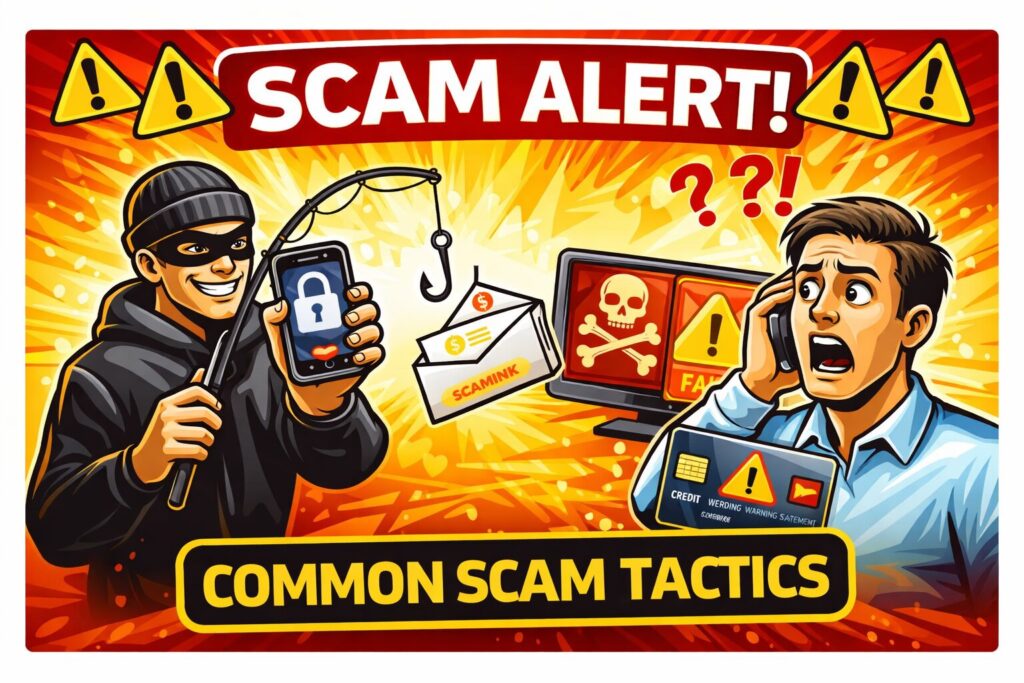
Florida consistently ranks among the top five most-scammed states in the country. In the first half of 2025 alone, Floridians filed over 71,000 fraud reports representing nearly $400 million in losses — and those are just the cases that got reported. Most victims never file a complaint. They feel embarrassed, or they don’t know where to turn, or they just want to move on.
In 2026, the scams haven’t slowed down. They’ve gotten smarter. Scammers now use Google Ads, fake social media accounts, AI-generated reviews, and sophisticated call center operations that make fly-by-night operations look like established local businesses. You can’t rely on star ratings or a local phone number to tell you whether someone is legitimate.
This guide breaks down the most common tactics being used across all industries in Florida right now — with extra focus on locksmith scams, because that’s one of the most predatory and fastest-growing fraud categories we see reported in Brevard County and across the Space Coast.
The Universal Warning Signs — Any Industry
Before we get into specifics, here are the red flags that apply no matter who you’re dealing with — locksmith, roofer, contractor, utility company, or tech support:
1. The Price Changes the Moment They Arrive
This is the single most common tactic across every service industry. You get a quote on the phone — $35, $50, $75 — and the moment the technician sees your situation in person, the price doubles or triples. The excuse varies: “special equipment required,” “commercial-grade materials,” “this model is more complex than we expected.” In every case, the original price was designed to get them in the door. The real charge was always what they planned to collect.
We’ve seen this in report after report in our Florida Scam Database. A Palm Bay resident got a $45 rekey quote over the phone; the tech arrived and demanded $320. A Titusville homeowner called a 24-hour locksmith at midnight for a $55 quote; the tech appeared an hour late and announced a $389 total. A Cocoa Beach tourist got a $45 car lockout quote that became $220 on the spot.
What to do: Get a firm, written price — by text or email — before anyone begins work. “Firm” means the total you will pay, not an estimate. If the tech tries to raise the price after arriving, you have the right to pay them nothing and send them away.
2. The Fake Local Address
Scam operations spend money on Google Ads and Google Business Profile listings that show a local address — sometimes in your exact neighborhood. When you look them up you see a Melbourne or Palm Bay or Cocoa Beach address with a (321) number. It feels local. It isn’t. These addresses are almost always UPS Store mailboxes, virtual offices, or completely fabricated. The phone routes to a call center that dispatches whoever is driving through your area that day.
A Melbourne resident called a locksmith whose Google Maps listing showed a Melbourne address with hundreds of five-star reviews. The address was a virtual office. The phone went to a call center out of state. The tech who showed up had no uniform, no ID, and no actual connection to the company name on the website.
What to do: Search the business name alongside the word “scam” or “complaint.” Look them up on the Florida DBPR license lookup at MyFloridaLicense.com. A real local business will have a verifiable license number, a real street address, and usually a recognizable name in the community.
3. Fake Reviews Across Every Platform
Google reviews, Yelp reviews, Facebook recommendations, Nextdoor posts — all of them can be faked, and all of them are actively being faked in Brevard County in 2026. A Viera homeowner called a locksmith that was recommended in her Nextdoor neighborhood group, with several glowing replies underneath. Every one of those accounts was new, had no posting history, and disappeared shortly after.
Fake reviews are not just a locksmith problem. We see the same tactic used by scam roofers, pool contractors, furniture sellers, and handymen. The review profile looks legitimate. The star rating is high. The problem is you have no way to verify whether those reviewers are real people or paid accounts.
What to do: Read the actual text of the reviews. Generic language like “great service, highly recommend!” with no specific details is a warning sign. Look for reviews that mention the tech by name, describe the specific job, or reference the neighborhood. Check for a pattern of reviews that all appeared around the same time. And always verify the license independently.
4. Manufactured Urgency
Scammers depend on you making a decision before you have time to think. That’s why so many scams happen during emergencies — you’re locked out of your car in a parking lot, your power is supposedly being shut off in 30 minutes, your grandson is allegedly in jail and needs bail money right now. The urgency is either real and being exploited, or completely manufactured.
A Palm Bay resident received an unsolicited text from a locksmith advertising a “neighborhood promotion.” She happened to need rekeying, called immediately, and ended up in a bait-and-switch situation. The urgency of the deal — a limited-time promotion — overrode the caution she would have applied otherwise.
What to do: Force a pause. Even 60 seconds to search the company name, ask a neighbor, or call someone you trust can break the urgency spell. No legitimate business will penalize you for taking two minutes to verify who they are.
5. Targeting Vulnerable People
Elderly residents are disproportionately targeted by service scams, and for a calculated reason. They tend to be home during business hours, they may be less familiar with current pricing or technology, and they are more likely to feel intimidated or embarrassed when pressured by a tradesperson. A Merritt Island woman in her 70s was charged $550 for a garage door issue that her son fixed in ten seconds — the tech had simply replaced a $12 lock cylinder and left the actual problem untouched.
Tourists are similarly targeted. A family visiting Cocoa Beach was hit with a $220 car lockout bill when the quoted price was $45. They were on vacation, in an unfamiliar area, with children present — exactly the combination of vulnerability these scammers look for.
What to do: If you have an elderly parent who lives alone, give them the name and number of a locksmith, plumber, and electrician you have personally vetted. Put it on the refrigerator. If they call someone, have them call you first or have a trusted neighbor present.
The Locksmith Scam Playbook — Tactics We See Again and Again
Locksmith fraud deserves its own section because it is one of the most systematically organized scam industries in Florida. These aren’t random opportunists — many operate as franchises, running dozens of fake local listings simultaneously across a region, dispatching vans, and rotating phone numbers to avoid complaints. Here’s exactly how they operate.
The $29 Service Call That Was Never Real
If a locksmith quotes you less than $100 for any service call — lockout, rekey, key cutting, safe opening, anything — stop right there. That price is a lure, not a real quote. It exists for one reason: to get a technician in front of you before you have a chance to shop around or verify who you’re dealing with.
Here’s what real locksmith pricing looks like in Brevard County and across Florida in 2026:
- Vehicle lockout: $120–$150 depending on time of day. After-hours and weekend calls are on the higher end. That’s it. No specialty fees, no “anti-theft surcharges,” no drilling required.
- Residential lockout: $95–$135 for a standard door. A licensed locksmith with the right tools can have a standard residential lock open in under 10 minutes without damaging anything.
- Rekey (per lock): $20–$35 per lock cylinder plus service call on a standard residential lock. A full house rekey of 4–5 locks should run $140–$180 total, depend on how many locks.
- Lock replacement (customer-supplied hardware): $45–$75 labor. If a locksmith won’t install hardware you purchased yourself, walk away.
- Safe opening (standard residential): $150.00 – $450.00 and for manipulation. Drilling a basic Sentry or Master safe is never necessary for a qualified technician.
Any quote significantly below these numbers is designed to get them in your driveway. Once they’re there, the pressure to pay whatever they claim begins. The scam reports in our database are full of $35 and $45 phone quotes that became $300, $400, and $550 the moment a tech arrived.
A properly equipped locksmith working a vehicle lockout — someone who carries air wedges, long-reach tools, and a slim jim — can get into the overwhelming majority of passenger cars and trucks in 10 minutes or less without touching the lock cylinder at all. If a tech claims your car requires drilling, a special tool they don’t have, or a procedure that will cost $200+ for what should be a simple lockout, they either lack the skills or they’re running a scam. Either way, call someone else.
What to do: When you call a locksmith, ask two questions before you agree to anything: “What is your firm, all-in price for this service?” and “Do you carry air wedge and long-reach tools for vehicle entry?” A legitimate locksmith will answer both questions clearly and confidently. A scammer will hedge, change the subject, or tell you they need to see the vehicle first before quoting.
The Google Ad Trap
When you’re locked out and you search “locksmith near me,” the top results are paid ads. Scam locksmith operations spend heavily on Google Ads because they know that’s where panicked people click first. The ad shows a local phone number, a local address, and often a high star rating pulled from a fake Google Business Profile. The number routes to a call center. The tech dispatched to you has no connection to the business name you called.
Multiple Brevard County residents in 2026 called locksmiths from the top of Google results — in Melbourne, Cocoa Beach, Satellite Beach, Cape Canaveral — and every single one of those “local” businesses turned out to be the same type of operation: fake address, out-of-state call center, traveling tech in an unmarked van.
What to do: Scroll past the ads. Look for organic results from businesses with actual websites, real about pages, and named owners. Or better yet, save a legitimate local locksmith’s number before you ever need one.
The Unnecessary Drill
This is the most destructive locksmith scam tactic. The tech arrives, looks at your lock for 30 seconds, announces it requires “destructive entry,” and starts drilling before you fully understand what is happening. Drilling destroys your lock and automatically creates a sale — now you need a new lock cylinder, which the tech conveniently has in his van for $150–$300 above retail.
Here’s the truth: a standard residential deadbolt — Kwikset, Schlage, Baldwin — almost never needs to be drilled. Any competent locksmith can pick or bypass these locks non-destructively in minutes. A Cape Canaveral resident had her standard Kwikset deadbolt drilled and was charged $390 for a replacement. The replacement lock was the same model she already had, available at Home Depot for $28.
What to do: Before any tech touches your lock, ask directly: “Can you pick this lock without drilling?” If the answer is no and they haven’t even tried, that is a red flag. Drilling should be a last resort, not a first move.
The “Special Lock” Upsell
One of the most reliable locksmith scam lines is claiming your completely ordinary lock is a rare, exotic, or high-security model that requires specialty tools or a more expensive procedure. We have seen this used on: standard Kwikset deadbolts (called “Grade 1 security locks”), standard Schlage B60N deadbolts (called “reinforced commercial-grade cylinders”), basic Sentry safes sold at Walmart (called “Class B fire-rated vaults”), and standard garage door lock cylinders (called “seized commercial mechanisms”).
None of these descriptions were accurate. All of them were used to justify dramatically higher prices.
What to do: Look up your lock model before the tech arrives if you can. Most locks have the brand name stamped on the face. Search the model name and “rekey cost” or “lockout cost” to get a realistic price range. If the tech’s quote is three times the market rate, something is wrong.
Vehicle Documents, Key Codes, and NASTF — What a Legitimate Locksmith Actually Needs
Here’s something important that the internet gets wrong — and that scammers exploit as cover for bad behavior.
For certain automotive key replacement jobs — particularly when a locksmith needs to order security key codes or access a vehicle’s immobilizer data — photographing your registration and driver’s license is not only legitimate, it is federally required. This is not a scam. It is part of a heavily regulated system called the NASTF Secure Data Release Model (SDRM).
NASTF stands for the National Automotive Service Task Force — a nonprofit organization founded in 2000 that works with automakers to give licensed, vetted locksmiths access to vehicle security data that would otherwise only be available through dealerships. To gain access to this system, a locksmith must pass an intensive criminal background check, carry business liability insurance and a fidelity bond, hold a valid state locksmith license, and have their application notarized. Once approved, they are issued a Locksmith Secure Identification (LSID) number and registered as a Vehicle Security Professional (VSP) in the NASTF registry.
When that registered locksmith needs to pull key codes or immobilizer data for your specific vehicle, they are required to upload a D1 form along with documentation proving you authorized the work — which means a copy of your driver’s license and your vehicle registration or title. This is not optional. NASTF requires it. Automakers require it. The documentation is uploaded directly into a secure, monitored system and is tied to the locksmith’s registered credentials. Every transaction is logged.
In other words: a legitimate locksmith photographing your registration and license for a key code job is doing exactly what the law requires. The difference between that and a scam is everything else around it — are they a registered VSP, do they have a valid LSID, and are they uploading those documents into the NASTF system or just pocketing your information?
How to tell the difference:
- Ask the locksmith: “Are you a registered NASTF Vehicle Security Professional?” A legitimate automotive locksmith will know exactly what you mean and can provide their LSID number.
- You can verify NASTF-registered locksmiths at nastf.org. The registry exists specifically so consumers can confirm who they’re dealing with.
- A legitimate locksmith will explain the D1 process to you before asking for documents. They won’t just grab your paperwork and take photos without telling you why.
- If a locksmith is photographing your documents for a simple lockout or a standard rekey — jobs that don’t involve security codes — that is a red flag. Document collection is only required for key code and immobilizer access jobs.
How to Find a Verified, Legitimate Locksmith
Two resources exist specifically for finding vetted locksmiths — neither of which scam operations can get listed on:
- findalocksmith.com — run by ALOA (Associated Locksmiths of America), the largest professional locksmith association in the country. Every locksmith listed has been vetted and cleared by existing ALOA members and must adhere to a code of professional ethics. Search by zip code to find a verified locksmith near you.
- nastf.org — for automotive key and immobilizer work specifically. You can verify whether a locksmith is a registered Vehicle Security Professional before letting them touch your vehicle’s security system.
- MyFloridaLicense.com — verify any Florida locksmith’s state license is active and in good standing before they begin any work.
Save those links before you need them. The worst time to vet a locksmith is when you’re standing in a parking lot at night with your keys locked in the car.
The Rental Property Multi-Lock Upsell
Landlords and property managers are targeted specifically because they often need multiple locks rekeyed at once, which multiplies the upsell opportunity. A Rockledge landlord called a locksmith for a six-lock rekey and received a quote of $22 per lock over the phone. When the tech arrived, four of the six identical Kwikset locks were suddenly “commercial-grade” requiring $85 each. The total jumped from $132 to $384 — nearly triple.
What to do: If you own rental properties, find a licensed local locksmith during a non-emergency moment and establish a relationship. Get a written price sheet for standard services. This is far easier than vetting a stranger under pressure at a vacant property.
Automotive Key Programming Fraud
Car key replacement is a high-value service — a legitimate smart key replacement with programming runs $200–$400 depending on the vehicle. Scam locksmiths exploit this by claiming your specific vehicle requires dealer-only equipment they don’t have, then either abandoning the job after collecting a trip fee or inflating the price to $600+.
A Brevard County resident needed a Toyota RAV4 key and was told the vehicle required OEM Toyota software available only through dealerships — and that the locksmith could offer a “valet key” that only starts the car but doesn’t control the fob for $175. That product does not exist. Any equipped automotive locksmith can program a 2019 Toyota smart key.
What to do: Before calling any locksmith for key programming, look up your year/make/model alongside “smart key programming locksmith” to understand what the service involves and what it should cost. If a locksmith claims they can’t program your specific key, call another locksmith before accepting their referral to a dealer.
When a Bad Locksmith Costs You Your Entire Car
This story is one of the worst outcomes we’ve heard — and it needs to be told, because it shows just how much damage an unqualified scam locksmith can do.
A woman here in Florida lost her only set of keys to her Hyundai SUV. She searched Google, found a locksmith near the top of the results, and called. He came out, did what he called an assessment, and quoted her $400 to $500 to program a new key fob. Then he asked for full payment upfront before he would begin. She paid.
He spent nearly an hour trying to program the key. Then he stopped, told her he had brought the wrong key for her vehicle, and left. He never came back. He had her $400–$500, he was done, and he moved on to his next victim.
She had the car towed to the Hyundai dealership. The dealer inspected the vehicle and delivered the worst possible news: the locksmith’s repeated failed programming attempts had damaged the immobilizer module — the component that controls key recognition and allows the engine to start. That module was no longer in production. Hyundai could not source a replacement. Because the car could not be repaired to a driveable state, her insurance company declared it a total loss.
She lost her car over a key replacement. She was forced to go out and buy a new vehicle — an expense she never anticipated — while the locksmith who caused it had already vanished, phone disconnected, Google listing gone, on to the next town and the next victim.
This is not an isolated case. Hyundai and Kia immobilizer systems in particular — and this is critically important — require NASTF gateway validation credentials just to access the programming interface. A locksmith without a valid NASTF LSID number cannot legally or properly program a Hyundai or Kia smart key. If the person who showed up at her door had been a registered NASTF Vehicle Security Professional, they would have had the correct key blank confirmed before arriving, because they would have pulled the vehicle’s security data through the NASTF system first. The fact that he had the wrong key after spending an hour tells you everything about his qualifications.
What to do — and what never to do:
- Never pay upfront in full for any locksmith service. A legitimate technician does not require payment before the job is done. Full upfront payment is one of the clearest warning signs that someone plans to take the money and disappear.
- Ask if they are NASTF registered before any automotive key programming job. For Hyundai, Kia, Genesis, and many other modern vehicles, NASTF credentials are not optional — they are required to access the programming systems properly.
- Verify the locksmith has the correct key blank before they begin. Ask them to show you the key blank and confirm it matches your year, make, and model. A qualified automotive locksmith will have looked up your VIN before arriving.
- If a locksmith says they have the wrong key and needs to leave, do not let them leave with your money. Demand a refund immediately. If they refuse, dispute with your credit card company and report to BCSO at (321) 264-5100.
- For Hyundai, Kia, and other vehicles with sensitive immobilizer systems, verify NASTF registration at nastf.org before anyone touches your vehicle’s security system.
The Google locksmith in this story collected his money, caused thousands of dollars in irreversible damage, and was never held accountable. That’s how these operations work. They move fast, they move on, and the person left holding the bill is you.
Other Scams Hitting Florida Hard in 2026
Roofing and Storm Chaser Contractors
After any storm, unlicensed contractors canvass neighborhoods offering free roof inspections. The real target is getting you to sign an Assignment of Benefits agreement — a legal contract that transfers your insurance rights to them, allowing them to collect directly from your insurer for work you may not even need. A Palm Bay resident signed what she thought was a free inspection form and ended up with a $14,000 insurance claim filed in her name for work that was never done.
Never sign anything a roofing contractor puts in front of you on a tablet. Read the full document. Verify their license at MyFloridaLicense.com before any work begins.
Wire Fraud in Real Estate
A Brevard County resident nearly lost $1.7 million in a real estate closing. She received an email that appeared to be from her title company with updated wire instructions. The email address was spoofed — one letter different from the real one. She wired the funds to the fraudulent account. The BCSO Economic Crimes Task Force recovered the money the same evening — but most victims are not that lucky.
Always verify wire transfer instructions by calling your title company directly using a phone number you look up independently — never from the email itself.
Fake Utility Shutoff Calls
Scammers call claiming to be FPL or Duke Energy, saying your power will be disconnected in 30 minutes unless you pay immediately via prepaid cards. They know your name and address — often pulled from public records — which makes the call feel real. FPL will never demand immediate payment by gift card. Ever. If you get this call, hang up and call FPL directly at 1-800-226-3545.
Medicare DNA Testing Fraud
Representatives approach seniors at health fairs offering free DNA cancer screenings. All they ask for is your Medicare number. That number is then used to submit thousands of dollars in fraudulent claims for services never rendered. Medicare only covers one genetic cancer test — the Cologuard colorectal screening — and only when ordered by your own physician. Do not give your Medicare number to anyone who approaches you unsolicited.
Pool Contractor Deposit Fraud
Legacy Pools — a company operating across Brevard, Orange, and Osceola counties — collected more than $2 million in deposits from over 300 homeowners and never built a single pool. Florida law limits contractor deposits to 10% of the total contract or $1,000, whichever is less. Any contractor demanding more than that upfront is breaking the law.
The Red Flag Checklist — Before You Hire Anyone
Before you hire any service provider — locksmith, roofer, contractor, plumber — run through this quick checklist:
- ✅ Is their Florida license verifiable at MyFloridaLicense.com?
- ✅ Do they have a real physical address — not a UPS Store or virtual office?
- ✅ Did you get a firm written price before any work began?
- ✅ Did they arrive in a marked vehicle with a uniform and ID badge?
- ✅ Are the reviews specific and detailed, not generic filler?
- ✅ Did you search their business name alongside “scam” or “complaint”?
- ✅ Was the quote $100 or more? Anything under $100 for a service call is bait.
- ✅ For lockouts: did they confirm they carry air wedge and long-reach tools?
- ✅ For automotive key work: are they a registered NASTF Vehicle Security Professional? Verify at nastf.org.
- ✅ For key programming: never pay in full upfront — pay when the job is complete.
- ✅ For key programming: did they verify the correct key blank for your vehicle before starting?
- ✅ For contractors: did you verify they are licensed and insured before they touched anything?
- ✅ For any wire transfer: did you verify instructions by phone using a number you found independently?
Where to Find a Verified Locksmith & Where to Report Scams
Find a verified locksmith:
- findalocksmith.com — ALOA-verified locksmiths, searchable by zip code
- nastf.org — verify NASTF Vehicle Security Professional registration for automotive key work
- MyFloridaLicense.com — verify any Florida locksmith’s active state license
Report a scam:
- FTC — reportfraud.ftc.gov — all types of fraud and identity theft
- FBI IC3 — ic3.gov — online fraud, wire fraud, cybercrime
- Florida Attorney General — myfloridalegal.com or (866) 966-7226 — contractor fraud, business scams
- FL Dept. of Financial Services — (800) 378-0445 — contractor fraud, insurance fraud
- FL DBPR — myfloridalicense.com — unlicensed contractors and service providers
- Brevard County Sheriff’s Office — (321) 264-5100 — local fraud and economic crimes
You can also add your experience to the OnlyTopic Florida Scam Database — a free, community-powered resource where Brevard County and Florida residents report scammers by name, phone number, and company. Search before you hire. Report after you’ve been hit. Help protect your neighbors.
This post was compiled using verified fraud reports submitted to the OnlyTopic Florida Scam Database, public records from the Brevard County Sheriff’s Office, and data from the Florida Attorney General’s Consumer Protection Division. If you have a scam to report, visit onlytopic.com/report-a-scam.